Pakistan continues to grapple with severe climate-related disasters, with floods now an almost annual crisis. In 2025, relentless rainfall led to widespread flooding across South Punjab, devastating homes, farmland, and livelihoods. Thousands of families were uprooted, forced to abandon everything they owned.
To respond to this humanitarian emergency, Aiming Change for Tomorrow (ACT), in partnership with the World Food Programme (WFP), launched an Unconditional Cash Assistance Programme for flood-affected households. Following a rigorous verification and registration process in Union Councils Bakhtiari and Khairpur Daha of Ahmadpur, 9,300 families each received PKR 15,000. This support enabled them to meet urgent needs and begin rebuilding their lives with dignity.
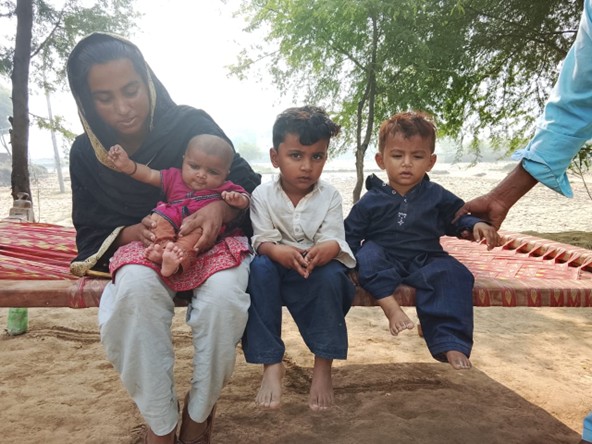
Rabia Azhar, a 23-year-old resident of Wadhnoor village in tehsil Ahmadpur, is a young mother of three children including one infant. The devastating floods changed her life forever. Her husband, Muhammad Azhar, worked as a daily wage labourer and was the family’s sole breadwinner. While traveling for work during the severe flooding, he was swept away by the raging waters and tragically lost his life. In a single moment, Rabia lost her husband, her home, and her only source of income.
Now staying temporarily at a relative’s house, Rabia recalls those days with deep sorrow:
“I didn’t know how I would feed my children. I had nothing: no food, no clothes, no shelter.”
During this extremely difficult period, ACT field teams identified Rabia as one of the most vulnerable individuals in her community. With support from ACT and WFP, she received PKR 15,000 in unconditional cash assistance. For Rabia, this support was nothing short of a lifeline.
She used the funds to purchase food, medicines, and essential clothing for her children, helping stabilize her family during a time of profound uncertainty.
As a mother of three, her eldest son just three years old, another 18 months, and her youngest daughter only three months, Rabia carries immense responsibility alone. Her most urgent need now is safe shelter. With the next round of support, she hopes to repair her destroyed home and create a secure space for her children.
Reflecting on the assistance, Rabia shared softly, “This support arrived when I had nowhere to live. It brought hope back into my life.”